Even After the Horrors of the Black Death How Did Europe s Economy Begin to Grow Again

Citizens of Tournai bury plague victims. Item of a miniature from "The Chronicles of Gilles Li Muisis" (1272–1352). Bibliothèque royale de Belgique, MS 13076–77, f. 24v.
The Black Decease peaked in Europe betwixt 1348 and 1350 with an estimated one-3rd of the continent'due south population ultimately succumbing to the disease. Often simply referred to every bit "The Plague", the Black Death had both immediate and long-term effects on human population across the world every bit one of the most devastating pandemics in homo history. These included a series of biological, social, economic, political and religious upheavals which had profound effects on the course of earth history, specially the history of Europe. Symptoms of the bubonic plague included painful and enlarged or swollen lymph nodes, headaches, chills, fatigue, airsickness, and fevers, and within iii–five days, lxxx% of the victims would be expressionless.[i] Historians estimate that it reduced the total earth population from 475 meg to betwixt 350 and 375 million. In most parts of Europe, information technology took nearly eighty years for population sizes to recover, and in some areas more than 150 years.[ citation needed ]
From the perspective of many of the survivors, the effect of the plague may have been ultimately favorable, as the massive reduction of the workforce meant their labor was suddenly in college demand. R. H. Hilton has argued that those English peasants who survived found their situation to be much improved. For many Europeans, the 15th century was a gilt historic period of prosperity and new opportunities. The land was plentiful, wages high, and serfdom had all just disappeared. A century later, equally population growth resumed, the lower classes one time again faced deprivation and famine.[ii] [iii] [four]

The spread of the bubonic plague through Europe from 1347 to 1351
Decease toll [edit]
Figures for the expiry toll vary widely by area and from source to source, and estimates are frequently revised as historical enquiry brings new discoveries to light. Most scholars guess that the Black Death killed up to 75 one thousand thousand people[5] in the 14th century, at a time when the entire earth population was nonetheless less than 500 one thousand thousand.[6] [7] Fifty-fifty where the historical record is considered reliable, simply rough estimates of the total number of deaths from the plague are possible.
Europe [edit]
Europe suffered an specially pregnant death toll from the plague. Modern estimates range between roughly one-third and ane-half of the total European population in the five-twelvemonth period of 1347 to 1351 died, during which the most severely afflicted areas may have lost upwards to 80% of the population.[eight] Contemporary chronicler Jean Froissart estimated the toll to be one-third, which mod scholars consider less an authentic assessment than an innuendo to the Book of Revelation meant to propose the scope of the plague.[9] Deaths were not evenly distributed across Europe, with some areas affected very little while others were all but entirely depopulated.[ten]
The Blackness Death striking the culture of towns and cities unduly difficult, although rural areas (where virtually of the population lived at the fourth dimension) were also significantly affected. Larger cities were the worst off, as population densities and shut living quarters made disease transmission easier. Cities were as well strikingly filthy, infested with lice, fleas, and rats, and subject to diseases caused by malnutrition and poor hygiene.[11] The population of the urban center of Florence was reduced from 110,000–120,000 inhabitants in 1338 to l,000 in 1351. In the cities of Hamburg and Bremen, 60–70% of the inhabitants died. In Provence, Dauphiné, and Normandy, historians observe a decrease of threescore% of fiscal hearths. In some regions, two-thirds of the population was annihilated. In the town of Givry in the Bourgogne region of French republic, the local friar, who used to note 28–29 funerals a year, recorded 649 deaths in 1348, half of them in September. Virtually half the population of Perpignan died over the class of several months (simply two of the viii physicians survived the plague). Over 60% of Norway's population died between 1348 and 1350.[12] London may take lost two-thirds of its population during the 1348–49 outbreak;[13] England as a whole may take lost 70% of its population, which declined from 7 million earlier the plague to ii one thousand thousand in 1400.[14]
Some places, including the Kingdom of Poland, parts of Hungary, the Brabant region, Hainaut, and Limbourg (in modern Kingdom of belgium), likewise as Santiago de Compostela, were unaffected for unknown reasons. Some historians[15] take assumed that the presence of resistant claret groups in the local population helped them resist infection, although these regions were touched by the second plague outbreak in 1360–1363 (the "lilliputian mortality") and subsequently during the numerous resurgences of the plague (in 1366–1369, 1374–75, 1400, 1407, etc.). Other areas which escaped the plague were isolated in mountainous regions (eastward.m. the Pyrenees).
All social classes were affected, although the lower classes, living together in unhealthy places, were most vulnerable. Alfonso Eleven of Castile and Joan of Navarre (daughter of Louis X le Hutin and Margaret of Burgundy) were the only European monarchs to dice of the plague, merely Peter Four of Aragon lost his wife, his daughter, and a niece in six months. Joan of England, daughter of Edward 3, died in Bordeaux on her fashion to Castile to ally Alfonso'south son Pedro. The Byzantine Emperor lost his son, while in the Kingdom of France, Bonne of Luxembourg, the wife of the hereafter John Ii of France, died of the plague.
Asia [edit]
Estimates of the demographic effect of the plague in Asia are based on population figures during this time and estimates of the disease's price on population centers. The about severe outbreak of plague, in the Chinese province of Hubei in 1334, claimed up to eighty% of the population.[ citation needed ] China had several epidemics and famines from 1200 to the 1350s and its population decreased from an estimated 125 1000000 to 65 million in the late 14th century.[16] [17] [18]
The precise demographic upshot of the disease in the Middle East is very difficult to calculate. Bloodshed was particularly high in rural areas, including meaning areas of Gaza and Syria. Many rural people fled, leaving their fields and crops, and unabridged rural provinces are recorded equally being totally depopulated. Surviving records in some cities reveal a devastating number of deaths. The 1348 outbreak in Gaza left an estimated ten,000 people dead, while Aleppo recorded a death rate of 500 per solar day during the same year. In Damascus, at the disease's height in September and October 1348, a thousand deaths were recorded every day, with overall mortality estimated at between 25 and 38 percentage. Syrian arab republic lost a total of 400,000 people by the fourth dimension the epidemic subsided in March 1349. In dissimilarity to some higher mortality estimates in Asia and Europe, scholars such as John Fields of Trinity College in Dublin believe the mortality rate in the Middle Eastward was less than i-3rd of the full population, with higher rates in selected areas.
Social, environmental, and economical effects [edit]
Considering 14th-century healers were at a loss to explicate the cause of the Black Decease, many Europeans ascribed supernatural forces, earthquakes and malicious conspiracies, among other things, as possible reasons for the plague's emergence.[nineteen] No one in the 14th century considered rat control a way to ward off the plague, and people began to believe only God'south acrimony could produce such horrific displays of suffering and death. Giovanni Boccaccio, an Italian writer and poet of the era, questioned whether it was sent past God for their correction, or that it came through the influence of the heavenly bodies.[20] Christians accused Jews of poisoning public h2o supplies, alleging Jews of an effort to ruin European culture. The spreading of this rumor led to complete destruction of entire Jewish towns. In February 1349, two,000 Jews were murdered in Strasbourg. In August of the same twelvemonth, the Jewish communities of Mainz and Cologne were murdered.[21]
Where regime authorities were concerned, most monarchs instituted measures that prohibited exports of foodstuffs, condemned black marketplace speculators, set up toll controls on grain, and outlawed large-calibration fishing. At best, they proved mostly unenforceable. At worst, they contributed to a continent-wide downwardly spiral. The hardest-hit lands, similar England, were unable to buy grain away from France because of the prohibition, and from most of the remainder of the grain producers, because of crop failures from shortage of labour. Any grain that could be shipped, was eventually taken past pirates or looters to be sold on the blackness market. Meanwhile, many of the largest countries, well-nigh notably England and Scotland, had been at war, using up much of their treasury and exacerbating inflation. In 1337, on the eve of the first moving ridge of the Black Death, England and French republic went to war in what would become known as the Hundred Years' State of war. Malnutrition, poverty, disease and hunger, coupled with state of war, growing aggrandizement, and other economic concerns made Europe in the mid-14th century ripe for tragedy.
Historian Walter Scheidel contends, that waves of plague following the initial outbreak of the Black Death had a leveling issue that changed the ratio of land to labour, reducing the value of the old while boosting that of the latter, which lowered economic inequality past making landowners and employers less well-off, while improving the lot of the workers. He states, that "the observed improvement in living standards of the laboring population was rooted in the suffering and premature decease of tens of millions over the course of several generations." This leveling upshot was reversed by a "demographic recovery that resulted in renewed population force per unit area."[22] On the other hand, in the quarter century after the Black Death, it is articulate, that in England, many laborers, artisans, and craftsmen, those living from coin-wages lone, did suffer a reduction in real incomes, attributable to rampant aggrandizement.[23] In 1357, a third of holding in London was unused due to a severe outbreak in 1348–49.[xiii] Notwithstanding, for reasons that are still debated, population levels declined after the Black Expiry'south beginning outbreak until effectually 1420, and did not begin to ascent again until 1470, and so the initial Black Death event on its ain does not entirely provide a satisfactory caption to this extended period of decline in prosperity. See Medieval demography for a more than complete treatment of this effect, and current theories on why improvements in living standards took longer to evolve.
Effect on the peasantry [edit]
The great population loss brought favorable results to the surviving peasants in England and Western Europe. There was increased social mobility, as depopulation further eroded the peasants' already weakened obligations to remain on their traditional holdings. Seigneurialism never recovered. Land was plentiful, wages high, and serfdom had all but disappeared. Information technology was possible to motion about and ascent college in life. Younger sons and women especially benefited.[24] Every bit population growth resumed, however, the peasants again faced deprivation and famine.[3] [25]
In Eastern Europe, past contrast, renewed stringency of laws tied the remaining peasant population more tightly to the country than ever before through serfdom.
Furthermore, the plague'southward great population reduction brought cheaper country prices, more food for the average peasant, and a relatively big increase in per capita income among the peasantry, if not immediately, in the coming century. Since the plague left vast areas of farmland untended, they were made available for pasture and put more meat on the market; the consumption of meat and dairy products went upward, as did the export of beef and butter from the Low Countries, Scandinavia, and northern Frg. Withal, the upper class often attempted to stop these changes, initially in Western Europe, and more forcefully and successfully in Eastern Europe, by instituting sumptuary laws. These regulated what people (peculiarly of the peasant class) could wear, so that nobles could ensure that peasants did not begin to wearing apparel and deed as a higher course member with their increased wealth. Another tactic was to fix prices and wages, so that peasants could non demand more with increasing value. In England, the Statute of Labourers 1351 was enforced, meaning, no peasant could ask for more wages than in 1346.[26] This was met with varying success depending on the amount of rebellion it inspired; such a law was i of the causes of the 1381 Peasants' Defection in England.
The rapid development of the utilise was probably i of the consequences of the Black Decease, during which many landowning nobility died, leaving their realty to their widows and modest orphans.[ citation needed ]
Issue on urban workers [edit]
In the wake of the drastic population decline brought on by the plague, wages shot up and labourers could move to new localities in response to wage offers. Local and royal authorities in Western Europe instituted wage controls. These governmental controls sought to freeze wages at the former levels before the Black Decease. Inside England, for case, the Ordinance of Labourers, enacted in 1349, and the Statute of Labourers, enacted in 1351, restricted both wage increases and the relocation of workers.[27] If workers attempted to leave their current post, employers were given the right to have them imprisoned. The statute was poorly enforced in nigh areas, and farm wages in England on average doubled between 1350 and 1450,[28] though they were static thereonafter, until the cease of the 19th century.[29]
Cohn, comparing numerous countries, argues, that these laws were not primarily designed to freeze wages. Instead, he says, the energetic local and royal measures to control labor and artisans' prices was a response to elite fears of the greed and possible new powers of lesser classes that had gained new liberty. Cohn continues, that the laws reflect the anxiety that followed the Black Death's new horrors of mass bloodshed and destruction, and from aristocracy anxiety about manifestations, such as the flagellant movement and the persecution of Jews, Catalans (in Sicily), and beggars.[30]
Labour-saving innovation [edit]
By 1200, about all of the Mediterranean basin and most of northern Germany had been deforested and cultivated. Indigenous flora and fauna were replaced by domestic grasses and animals, and domestic woodlands were lost. With depopulation, this process was reversed. Much of the primeval vegetation returned, and abandoned fields and pastures were reforested.[31]
The Black Death encouraged innovation of labor-saving technologies, leading to higher productivity.[32] There was a shift from grain farming to creature husbandry. Grain farming was very labor-intensive, just animal husbandry needed only a shepherd and a few dogs and pastureland.[31]
Plague brought an eventual end of Serfdom in Western Europe. The manorial system was already in trouble, but the Blackness Expiry assured its demise throughout much of western and primal Europe past 1500. Severe depopulation and migration of the village to cities acquired an acute shortage of agricultural laborers. Many villages were abandoned. In England, more than 1300 villages were deserted betwixt 1350 and 1500.[31] Wages of labourers were high, but the rise in nominal wages following the Black Death was swamped past post-Plague inflation, so that real wages cruel.[29]
Labor was in such a short supply that Lords were forced to requite better terms of tenure. This resulted in much lower rents in western Europe. By 1500, a new form of tenure called copyhold became prevalent in Europe. In copyhold, both a Lord and peasant made their all-time business deal, whereby the peasant got use of the country and the Lord got a fixed almanac payment, and both possessed a copy of the tenure agreement. Serfdom did not end everywhere: it lingered in parts of Western Europe and was simply introduced to Eastern Europe after the Black Decease.[31]
At that place was also a change in the inheritance law. Before the plague, only sons and especially the elder son inherited the bequeathed property. Post-plague, all sons likewise as daughters started inheriting belongings.[31]
Persecutions [edit]
Renewed religious fervor and fanaticism came in the wake of the Blackness Death. Some Europeans targeted "groups such as Jews, friars, foreigners, beggars, pilgrims",[33] lepers[33] [34] and Romani, thinking that they were to blame for the crisis.
Differences in cultural and lifestyle practices also led to persecution. As the plague swept across Europe in the mid-14th century, annihilating more than half the population, Jews were taken every bit scapegoats, in part because better hygiene among Jewish communities and isolation in the ghettos meant that Jews were less affected.[35] [36] Accusations spread, that Jews had caused the disease by deliberately poisoning wells.[37] [38] Mobs attacked Jewish settlements across Europe; by 1351, lx major and 150 smaller Jewish communities had been destroyed, and more than 350 separate massacres had occurred.
According to Joseph P. Byrne, women also faced persecution during the Blackness Death. Muslim women in Cairo became scapegoats when the plague struck.[39] Byrne writes, that in 1438, the sultan of Cairo was informed by his religious lawyers, that the inflow of the plague was 'Allah's punishment for the sin of fornication,' and that in accord with this theory, a law was prepare in place stating that women were non immune to make public appearances, equally 'they may tempt men into sin.' Byrne describes, that this police was but lifted when "the wealthy complained that their female person servants could not shop for food."[39]
Faith [edit]
The Black Death hit the monasteries very difficult because of their proximity with the sick who sought refuge there. This left a severe shortage of clergy after the epidemic cycle. Somewhen the losses were replaced by hastily trained and inexperienced clergy members, many of whom knew lilliputian of the rigors of their predecessors. New colleges were opened at established universities, and the preparation process sped up.[forty] The shortage of priests opened new opportunities for laywomen to assume more all-encompassing and more of import service roles in the local parish.[41]

Flagellants adept cocky-flogging (whipping of oneself) to atone for sins. The movement became popular after the Blackness Expiry. It may exist that the flagellants' later involvement in hedonism was an endeavor to accelerate or absorb God'due south wrath, to shorten the time with which others suffered. More probable, the focus of attention and popularity of their cause contributed to a sense that the world itself was ending and that their private deportment were of no result.
Reformers rarely pointed to failures on the part of the Church in dealing with the catastrophe.[42]
Cultural effect [edit]

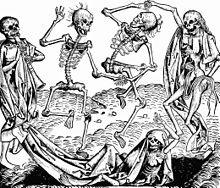
The Blackness Death had a profound effect on fine art and literature. After 1350, European culture in general turned very morbid. The general mood was ane of pessimism, and contemporary art turned night with representations of decease. The widespread image of the "trip the light fantastic toe of death" showed decease (a skeleton) choosing victims at random. Many of the nigh graphic depictions come from writers such every bit Boccaccio and Petrarch.[43] Peire Lunel de Montech, writing about 1348 in the lyric style long out of fashion, composed the following sorrowful sirventes "Meravilhar no·due south devo pas las gens" during the height of the plague in Toulouse:
They died by the hundreds, both mean solar day and nighttime, and all were thrown in ... ditches and covered with earth. And every bit presently as those ditches were filled, more were dug. And I, Agnolo di Tura ... cached my five children with my own easily ... So many died that all believed it was the cease of the world.[44]
Boccaccio wrote:
How many valiant men, how many fair ladies, breakfast with their kinfolk and the same dark supped with their ancestors in the side by side world! The status of the people was pitiable to behold. They sickened past the thousands daily, and died unattended and without aid. Many died in the open street, others dying in their houses, fabricated it known past the stench of their rotting bodies. Consecrated churchyards did not suffice for the burial of the vast multitude of bodies, which were heaped by the hundreds in vast trenches, like goods in a transport'southward hold and covered with a piddling earth.[45]
Medicine [edit]
Although the Black Expiry highlighted the shortcomings of medical science in the medieval era, it likewise led to positive changes in the field of medicine. As described by David Herlihy in The Black Death and the Transformation of the West, more emphasis was placed on "anatomical investigations" following the Blackness Expiry.[46] How individuals studied the human body notably inverse, becoming a process that dealt more than directly with the human body in varied states of sickness and health. Farther, at this fourth dimension, the importance of surgeons became more evident.[46]
A theory put along by Stephen O'Brien says, the Black Death is likely responsible, through natural selection, for the loftier frequency of the CCR5-Δ32 genetic defect in people of European descent. The gene affects T prison cell function, and provides protection against HIV, smallpox, and possibly plague,[47] though for the last, no explanation as to how it would exercise that, exists. This, however, is now challenged, given that the CCR5-Δ32 gene has been plant to be only as common in Statuary Age tissue samples.[48]
Architecture [edit]
The Black Death also inspired European compages to move in 2 dissimilar directions: (i) a revival of Greco-Roman styles, and (ii) a further elaboration of the Gothic style.[49] Tardily medieval churches had impressive structures centered on verticality, where one's eye is drawn up towards the high ceiling. The bones Gothic style was revamped with elaborate decoration in the tardily medieval period. Sculptors in Italian city-states emulated the work of their Roman forefathers while sculptors in northern Europe, no doubt inspired by the devastation they had witnessed, gave way to a heightened expression of emotion and an emphasis on individual differences.[l] A tough realism came forth in architecture equally in literature. Images of intense sorrow, decaying corpses, and individuals with faults as well every bit virtues emerged. North of the Alps, painting reached a pinnacle of precise realism with Early Dutch painting past artists such equally Jan van Eyck (c. 1390 – 1441). The natural earth was reproduced in these works with meticulous detail whose realism was not dissimilar photography.[51]
See also [edit]
- Economic consequences of population reject
- Impact of the COVID-nineteen pandemic
References [edit]
- ^ The Black Death Documentary, Oliver Wendell Holmes Middle Schoolhouse, 23 Oct 2015.
- ^ Barbara A. Hanawalt, "Centuries of Transition: England in the Later Middle Ages", in Richard Schlatter, ed., Contempo Views on British History: Essays on Historical Writing since 1966 (Rutgers University Printing, 1984), pp 43–44, 58
- ^ a b R. H. Hilton, The English language Peasantry in the Late Centre Ages (Oxford: Clarendon, 1974)
- ^ Scheidel, Walter (2017). "Affiliate 10: The Black Death". The Great Leveler: Violence and the History of Inequality from the Stone Historic period to the Xx-First Century. Princeton University Press. pp. 291–313. ISBN978-0691165028.
- ^ Dunham, Will (29 January 2008). "Black death 'discriminated' between victims". Australian Broadcasting Corporation. Retrieved 3 November 2008.
- ^ "De-coding the Black Expiry". BBC News. iii October 2001. Retrieved 3 Nov 2008.
- ^ Philipkoski, Kristen (3 October 2001). "Black Death's Factor Code Cracked". Wired . Retrieved 3 November 2008.
- ^ "The trend of recent research is pointing to a figure more than like 45% to fifty% of the European population dying during a 4-twelvemonth period. There is a fair corporeality of geographic variation. In Mediterranean Europe and Italy, the South of France and Spain, where plague ran for near four years consecutively, information technology was probably closer to 75% to 80% of the population. In Germany and England, it was probably closer to xx%." Philip Daileader, The Late Middle Ages, sound/video course produced by The Teaching Company, 2007. ISBN 978-ane-59803-345-8. Stéphane Barry and Norbert Gualde, in L'Histoire no. 310, June 2006, pp. 45–46, say "betwixt one-third and ii-thirds"; Robert Gottfried (1983). "Black Death" in Dictionary of the Eye Ages, volume 2, pp. 257–267, says "between 25 and 45 per centum". Daileader, every bit in a higher place; Barry and Gualde, every bit higher up, Gottfried, every bit above. Norwegian historian Ole J. Benedictow ("The Blackness Decease: The Greatest Catastrophe Always", History Today, Volume 55 Issue 3, March 2005; cf. Benedictow, The Black Death 1346–1353: The Complete History, Boydell Press (vii December 2012), pp. 380ff.) suggests a death rate as high as sixty%, or 50 one thousand thousand out of fourscore million inhabitants.
- ^ Jean Froissart, Chronicles (trans. Geoffrey Brereton, Penguin, 1968, corrections 1974), p. 111.
- ^ Joseph Patrick Byrne (2004). The Black Expiry. ISBN 0-313-32492-i, p. 64.
- ^ According to Kelly (2005), "[w]oefully inadequate sanitation made medieval urban Europe so illness-ridden, no city of whatever size could maintain its population without a abiding influx of immigrants from the countryside". The influx of new citizens facilitated the motion of the plague betwixt communities and contributed to the longevity of the plague within larger communities. Kelly, John. The Great Mortality: An Intimate History of the Black Death, the Near Devastating Plague of All Time. New York: HarperCollins, 2005, p. 68
- ^ Harald Aastorp (1 August 2004). "Svartedauden Enda verre enn antatt". Forskning.no. Archived from the original on 31 March 2008. Retrieved 3 Jan 2009.
- ^ a b Kennedy, Maev (17 August 2011). "Black Death study lets rats off the hook". The Guardian . Retrieved xviii August 2011.
- ^ Barry and Gualde 2006.
- ^ Stéphane Barry and Norbert Gualde, "La peste noire : la plus grande épidémie de fifty'histoire" [The Black Plague: the largest epidemic in history], in L'Histoire no. 310, June 2006, pp. 45–46
- ^ Spengler, Joseph J. (October 1962). "Review (Studies on the Population of Mainland china, 1368–1953 past Ping-Ti Ho)". Comparative Studies in Society and History. five (one): 112–114. doi:10.1017/s0010417500001547. JSTOR 177771. S2CID 145085710.
- ^ Maguire, Michael (22 February 1999). "Re: How many people recovered from Black Death (Bubonic Plague)". MadSci Network. ID: 918741314.Mi. Retrieved 3 Nov 2008.
- ^ King, Jonathan (8 Jan 2005). "World'due south long trip the light fantastic with death". The Sydney Morning Herald . Retrieved 3 November 2008.
- ^ Judith M. Bennett; C. Warren Hollister (2006). Medieval Europe: A Curt History. New York: McGraw-Hill. p. 329. ISBN0-07-295515-v. OCLC 56615921.
- ^ Boccaccio, Giovanni. "Boccaccio on the Plague". Virginia Tech. Archived from the original on six Feb 2016.
- ^ Bennett and Hollister, 329–30.
- ^ Scheidel, Walter (2017). The Keen Leveler: Violence and the History of Inequality from the Stone Historic period to the Twenty-First Century. Princeton University Press. pp. 292–93, 304. ISBN978-0691165028.
- ^ Munro 2004, p. 352. sfn fault: no target: CITEREFMunro2004 (assistance)
- ^ Jay O'Brien; William Roseberry (1991). Golden Ages, Dark Ages: Imagining the Past in Anthropology and History. University of California Printing. p. 25. ISBN978-0-520-07018-9.
- ^ Barbara A. Hanawalt, "centuries of Transition: England in the Later Middle Ages," in Richard Schlatter, ed., Contempo Views on British History: Essays on Historical Writing since 1966 (Rutgers UP, 1984), pp. 43–44, 58
- ^ "Statute of Labourers Act". Spartacus Educational.
- ^ Penn, Simon A. C.; Dyer, Christopher (1990). "Wages and Earnings in Late Medieval England: Prove from the Enforcement of the Labour Laws". The Economic History Review. 43 (3): 356–57. doi:10.1111/j.1468-0289.1990.tb00535.x.
- ^ Gregory Clark, "The long march of history: Subcontract wages, population, and economic growth, England 1209–1869," Economical History Review 60.ane (2007): 97–135. online, page 36
- ^ a b Munro, John H. A. (5 March 2005). "Earlier and After the Black Decease: Money, Prices, and Wages in Fourteenth-Century England". ideas.repec.org . Retrieved v August 2014.
- ^ Samuel Cohn, "Afterwards the Blackness Expiry: Labour Legislation and Attitudes Towards Labour in Belatedly-Medieval Western Europe," Economic History Review (2007) 60#3 pp. 457–85 in JSTOR
- ^ a b c d e Gottfried, Robert Southward. (1983). "seven". The black decease: natural and human being disaster in Medieval Europe (1. Gratuitous Press paperback ed.). New York: Gratuitous Press. ISBN0-02-912630-iv.
- ^ "Plagued by dear labour". The Economist. London. 21 October 2013. Retrieved 5 August 2014.
- ^ a b David Nirenberg, Communities of Violence, 1998, ISBN 0-691-05889-X.
- ^ R.I. Moore The Formation of a Persecuting Society, Oxford, 1987 ISBN 0-631-17145-2
- ^ Naomi E. Pasachoff, Robert J. Littman A Curtailed History of the Jewish People 2005. p. 154 "However, Jews regularly ritually done and bathed, and their abodes were slightly cleaner than their Christian neighbors'. Consequently, when the rat and the flea brought the Black Death, Jews, with improve hygiene, suffered less severely ..."
- ^ Joseph P Byrne, Encyclopedia of the Black Expiry Volume 1 2012. p. 15 "Anti–Semitism and Anti–Jewish Violence before the Black Decease ... Their attention to personal hygiene and diet, their forms of worship, and cycles of holidays were off-puttingly different."
- ^ Anna Foa The Jews of Europe Afterward the Blackness Death 2000 p. 146 "There were several reasons for this, including, it has been suggested, the observance of laws of hygiene tied to ritual practices and a lower incidence of alcoholism and venereal affliction"
- ^ Richard S. Levy Antisemitism 2005 p. 763 "Panic emerged again during the scourge of the Black Death in 1348, when widespread terror prompted a revival of the well poisoning accuse. In areas where Jews appeared to die of the plague in fewer numbers than Christians, possibly because of amend hygiene and greater isolation, lower mortality rates provided evidence of Jewish guilt."
- ^ a b Joseph P. Byrne, The Black Death (Westport, Conn.: Greenwood Printing, 2004), 108.
- ^ Steven A. Epstein, An Economic and Social History of Afterward Medieval Europe, 1000–1500 (2009) p. 182
- ^ Katherine L. French, The Adept Women of the Parish: Gender and Religion After the Black Death (U of Pennsylvania Printing, 2011)
- ^ Epstein, p. 182
- ^ J. One thousand. Bennett and C. West. Hollister, Medieval Europe: A Short History (New York: McGraw-Hill, 2006), p. 372.
- ^ "Plague readings". University of Arizona. Retrieved 3 November 2008.
- ^ Spignesi, Stephen (2002). Catastrophe!: The 100 Greatest Disasters of All Time. New York: Kensington Publishing Corp. p. 1.
- ^ a b David Herlihy, The Blackness Decease and the Transformation of the W (Cambridge, Mass.: Harvard University Press, 1997), 72.
- ^ Jefferys, Richard; Anne-Christine d'Adesky (March 1999). "Designer Genes". HIV Plus (three). ISSN 1522-3086. Archived from the original on fourteen February 2008. Retrieved 12 Dec 2006.
- ^ Philip Due west. Hedrick; Brian C. Verrelli (June 2006). "'Ground truth' for selection on CCR5-Δ32". Trends in Genetics. 22 (6): 293–96. doi:10.1016/j.tig.2006.04.007. PMID 16678299.
- ^ Bennett and Hollister, p. 374.
- ^ Bennett and Hollister, p. 375.
- ^ Bennett and Hollister, p. 376.
Further reading [edit]
|
|
External links [edit]
- John H. A. Munro, 2005. "Before and Afterwards the Black Death: Money, Prices, and Wages in Fourteenth-Century England," Working Papers munro-04-04, Academy of Toronto, Department of Economics
whitlamfortalwyneho.blogspot.com
Source: https://en.wikipedia.org/wiki/Consequences_of_the_Black_Death
0 Response to "Even After the Horrors of the Black Death How Did Europe s Economy Begin to Grow Again"
Post a Comment